
Annual report from the Albert Schweitzer Hospital in Lambaréné, Gabon
- 8 Minutes to read
- Written by Axonlab
- Corporate
Our technician, Markus Häuselmann, travels once a year to Gabon to maintain diagnostic equipment at the Albert Schweitzer Hospital, which is supported by Axonlab. We are happy to share his impressive report of the visit in spring 2023 here:
"As usual, the trip starts already on Friday evening with the pre-event check-in at Airfrance, as the next day's departure is scheduled very early. Already at 4.30 a.m. the alarm clock rings and it goes off to the airport. To leave so early and then wait four hours in Paris until the flight continues is not exactly ideal. But we can't influence the flight connections.
The journey runs well and also at the customs we are passed through without any control. Fortunately, this eliminates annoying discussions about the material we are carrying for the service work. Around 9 p.m. we reach our hotel; just in time before the kitchen closes.
Sunday is always reserved for organizing the necessary things on site. This includes a local SIM card so that we can be reached by the various contact points on site. Also the onward journey for Monday morning has to be coordinated with the cab driver, money has to be changed and some more.
The trip early on Monday morning to the Albert Schweitzer Hospital in Lambaréné runs better than expected. The driver is on time and the road is in a much better condition than in previous years. There has been a lot of renovation and construction so that the travel time from Libreville to Lambaréné is now only 5-6 hours instead of 6-7 hours. The travel time also always depends on the usual police and military controls, where the driver has to pay his toll every now and then. These fees can amount to a good 15% of the fare: Welcome to Africa.
After moving into the accommodation in Lambaréné, as always, there is first a short welcome talk with the director of the hospital and the recording of the pending work with the director of the research institute C.E.R.M.L..
Dinner is in the center of Lambaréné: grilled fish, fresh from the river. You get there by cab, where each passenger calls out where he wants to go and how much he wants to pay. If the direction is suitable for the driver, you can get in. As a rule, the pricing system is simple: every time you cross a bridge, you pay a surcharge, and after 9 p.m. you pay double the fare.
We find the equipment in the research station in good condition. The Micros 60 analyzers in the hospital, on the other hand, require a lot more work. It is important to invest enough time for maintenance - after all, the instruments are supposed to work again for a whole year. As a rule, 60-70 samples are measured per day.
The waiting room in the entrance area is always very crowded, and in addition to patients, there are sometimes dogs or chickens looking for shade in the waiting room.
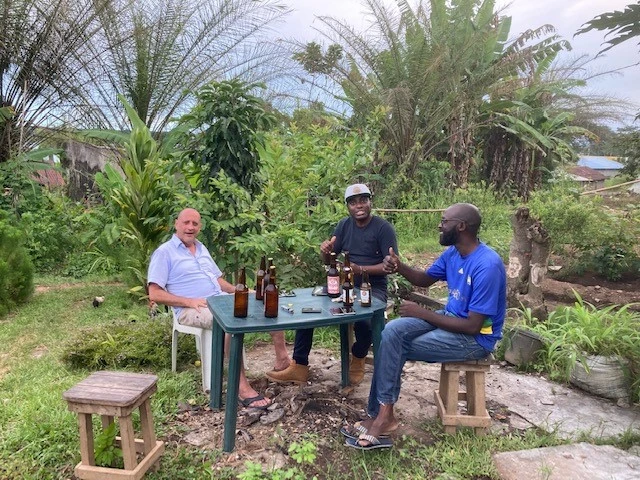
In the evening, you can also enjoy a beer with friends.
On Friday, we continue our journey over the weekend to the field office in Fougamou, which is about 100 km away from Lambaréné. In the morning we are picked up by Dr. Pierre Blaise to take care of his Micros and Pentra 60. He had to move out of his premises because of renovation works and has found a temporary place in the old hospital area in Fougamou. However, everything is very small and cramped, with three medical assistants completely overcrowded. In order to be able to do our maintenance work, the three employees spontaneously get time off.
On the way to Fougamou I noticed that compared to previous years there were only a few trucks with logs heading for Libreville. I wondered if this had something to do with a reduction in logging. At the very moment I have this thought, a huge convoy of over 15 trucks with trailers full of tropical timber passes the hospital... I wonder how many jungle giants will remain? During the first visit 12 years ago, such giants were still found in the Fougamou area, today they are cut from much further away. The big ships for export are already waiting in the harbor, the hunger for tropical wood is endless.
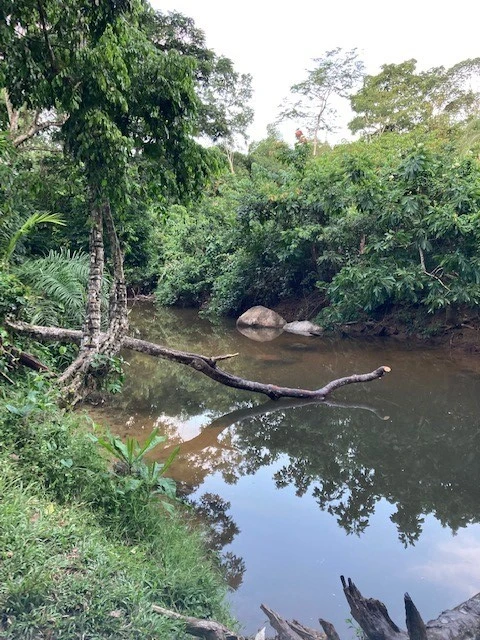
After Saturday's work is done, it is always a special treat on Sunday to jump into the nearby cool river. This is no longer a hidden secret, about 30 villagers are enjoying themselves, jumping and laughing, and we are in the middle of it.
Gradually it becomes quieter and we enjoy the unique atmosphere.
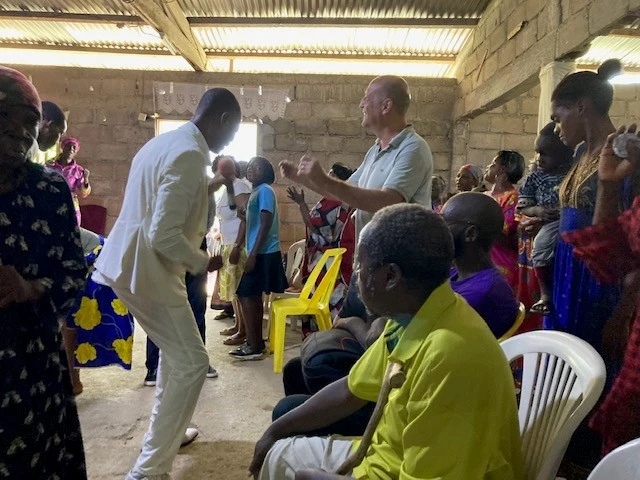
But where have all the people suddenly gone? Oh right, it's Sunday and we pass by the "church". However, not unnoticed. We are escorted to the front and greeted by the priest. Everything is entirely musical, because in Africa people sing and dance loudly in church. So we are also immediately animated by the priest to dance along.
On Monday we are picked up for a new installation with training. We had spontaneously learned that a completely new field office was being set up for research purposes in Sindara. For this purpose, a Microsemi, a SPOTCHEM SP-4430 and a SPOTCHEM SP-1520 were purchased from our Axonlab branch in Le Mont.
The drive from Fougamou to the new field office takes about 40 minutes and we are ready for a new adventure. After a wild drive on natural roads with big potholes we reach a completely autonomous new building. A simple building with a large laboratory and offices on the first floor and living quarters for the employees on the upper floor. The building is powered by a solar system and a diesel generator for support. Even a water hole was drilled to be completely independent.
The Microsemi is a completely new piece of equipment for the employees of the Sindara field office - training is therefore very welcome. A good group of six people is formed and we gladly pass on our knowledge about the instrument and support with documents in French.
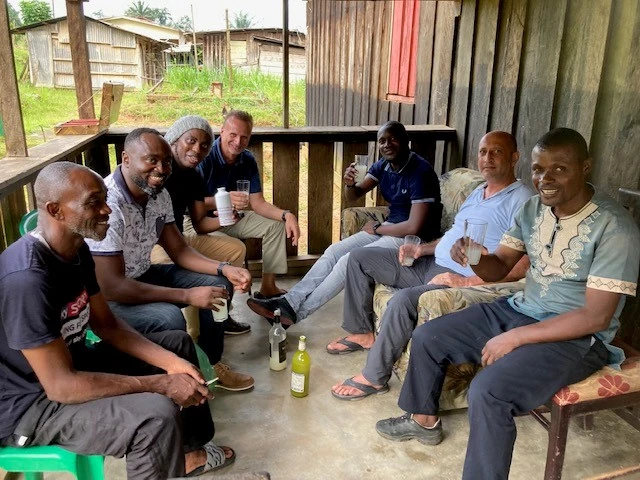
To conclude the successful training in a fitting manner, we are invited to drink palm wine from the local brewery afterwards. The invitation may not be refused in any case, as it is a sort of ritual.
Another exciting mission in West Africa is coming to an end."