

Welcome to the Jungle - Part 2
- 15.5 Minutes to read
- Written by Axonlab
- Life Science

The landscape of chemical qualities and specifications
After the first part dealt with definitions and non-regulated qualities, the second part of this series of topics will present regulated qualities and recommendations for the use of chemicals for specific purposes.
As mentioned above, there are also quality requirements for chemicals that have clear specifications based on a literature source. Examples are the references of the pharmacopoeias (USP, EP, BP, JP, CP, IPC, etc.), the book ‘Reagent Chemicals’ published by the American Chemical Society (ACS) and the ISO standard 6353-3 ‘Reagents for chemical analysis’.
The United States Pharmacopoeia (USP) specifies the use of chemicals with ACS specifications, unless the specifications for the reagents are otherwise described in the compendium. Compendial specifications of the USP are usually described for chemicals with Reag. USP for chemicals. If a reagent is not defined in either ACS specification or compendial, the reagent should be ‘fit for purpose’.
Below you will find the USP citation:
United States Pharmacopoeia (USP) - GENERAL NOTICES AND REQUIREMENTS, Chapter 6.70
‘The proper performance of the compendial procedures and the reliability of the results depend in part on the reagents used in performing the procedures. Unless otherwise specified, reagents shall be used that conform to the specifications in the current edition of Reagent Chemicals published by the American Chemical Society (ACS). If such ACS specifications for reagents are not available or if the required purity differs, compendial specifications for reagents of acceptable quality are provided (see the Reagents, Indicators and Solutions section of the USP-NF). Reagents not covered by one of these specifications should be of a quality suitable for the proper performance of the method, test or assay concerned.’
The European Pharmacopoeia (Pharmacopoeia Europaea, Ph. Eur.) describes suitable reagents in Chapter 4 Reagents and subsections. The Ph. Eur. assumes that reagents of analytical quality are used. Reagents that fulfil the specifications of the Ph. Eur. are commonly referred to as Reag. Ph. Eur.
You can also read the quote from the ‘General notices’ here:
Pharmacopoeia Europaea (Ph. Eur.) - General notices - Chapter 1.2.7 - Reagents and Solvents
‘The proper performance of the compendial procedures described in the Ph. Eur. and the reliability of the results depend in part on the quality of the reagents used. The reagents are described in Ph. Eur. under 4. Reagents and subsections. It is assumed that reagents of analytical quality are used; for some reagents suitability tests are included in the description.’
Chemicals that bear the designation ACS fulfil the specifications from ‘Reagent Chemicals’ of the American Chemical Society (ACS Reagent Chemicals: Specifications and Procedures for Reagents and Standard-Grade Reference Materials, 11th Edition, 2016).
Chemicals that bear the ISO designation fulfil the specifications of the international standard ISO 6353-3:1987 Reagents for chemical analysis - Part 3: Specifications.
After interested readers have learnt a lot about the purity, specifications and qualities of chemicals, everyone will be asking themselves when it is best to use which chemical. This question is not always easy to answer, as there are very different requirements for chemical quality depending on the intended use.
Chemicals for synthesis
In organic chemistry laboratories in particular, the synthesis and purification of compounds is one of the main objectives. The quality requirements depend on the various phases in the synthesis process.
| Grade | Description |
| For synthesis | Solvent for organic syntheses. The minimum purity is normally higher than 99.5%.The non-volatile components and the water content are specified. |
| Dry solvents | Solvents with extremely low water content that have been specially developed for very moisture-sensitive syntheses. |
| For analysis by GC | Reagents for gas chromatography carefully controlled by GC-ECD and GC-FID. |
| For IR analysis | Reagents for use in infrared spectroscopy (Music tip: Placebo, Infra-Red, 2006). |
| For UV, IR and HPLC | Solvents for use in spectroscopy (ultraviolet and infrared) and HPLC (Music tip: U2, Ultra Violet, 1992). |
Analytical reagents for general applications
In chemical analysis, the accuracy of the results is particularly important. The use of reagents of appropriate quality is therefore also crucial.
| Grade | Description |
| Technical | Chemicals of appropriate purity do not follow any official quality standards in terms of minimum content. As a rule, the product has a purity of at least 90%. |
| Volumetric solutions | Solutions with a known factor for titration. Ready-to-use solutions that are traceable to NIST Standard Reference Materials. Traceability is an unbroken chain of comparisons (calibrations) traceable to a recognized standard, usually an SI unit or artefact. |
| Buffer solutions | Ready-to-use buffer solutions, also traceable to NIST Standard Reference Materials. |
| Pure, pharmaceutical grade | products of appropriate purity for use as an aid in chemical analyses. Chemicals that fulfil the purity requirements of the pharmacopoeia monographs and can therefore be used in the pharmaceutical industry. |
| For analysis | Reagents that are especially suitable for general analytical applications. |
| For analysis (Reag. Ph. Eur.), ACS, ISO |
Reagents specifically designed for general analytical applications. The designation ACS indicates that the product meets or exceeds the analytical reagent requirements established by the American Chemical Society. The designation ISO means that the product meets or exceeds the analytical reagent requirements established by the International Organization for Standardization. The designation ‘Reag. Ph. Eur.’ means that the product fulfils the requirements described in the analytical reagents chapter of the Pharmacopoeia. |
Reagents for high-performance liquid chromatography (HPLC)
Reagents for high-performance liquid chromatography (HPLC) are high-purity solvents that have been specially developed for use in HPLC, ultra-high performance liquid chromatography (UHPLC), gel permeation chromatography (GPC), ion chromatography (IC) and GC.
Quality control includes IR, UV and purity (most solvents are 99.9%). They also have a very low evaporation rate and water content. All these solvents are micro-filtered (0.2 µm) and bottled in a nitrogen atmosphere. Other specifications are added depending on the product quality.
| Grade | Description |
| For UV, IR and HPLC | Solvents for use in spectrophotometry and HPLC / UHPLC. Strictly controlled for use in the analysis of pesticides and polyaromatic hydrocarbons (PAHs) by HPLC. Very high permeability with fluorescence and UV detectors. |
| Acids with a verylow metal content | Suitable for analyzing heavy metals and other elements in the ppm range. In most cases the content is below 0.1 ppb (μg/L). |
| For HPLC / UHPLC | Solvents for use in spectroscopy and HPLC / UHPLC. High transmittance in UV / fluorescence detectors. Very low non-volatile content. |
| For LC-MS | solvents for use in HPLC-MS. Very low metal concentrations and controlled by LC-MS. |
| For PAHs and pesticide analysis by HPLC / UHPLC | Solvent for use in spectrophotometry and HPLC / UHPLC. Strictly controlled for use in the analysis of polyaromatic hydrocarbons (PAHs) and pesticides by HPLC. Very high transmittance for fluorescence and UV detectors. |
| Standards for IC | Anion and cation standards, single element standard with a concentration of 1.000 g/L and multi-element standards in various concentrations. Traceable to NIST Standard Reference Materials. |
Application guide for the correct selection of quality solvents for HPLC
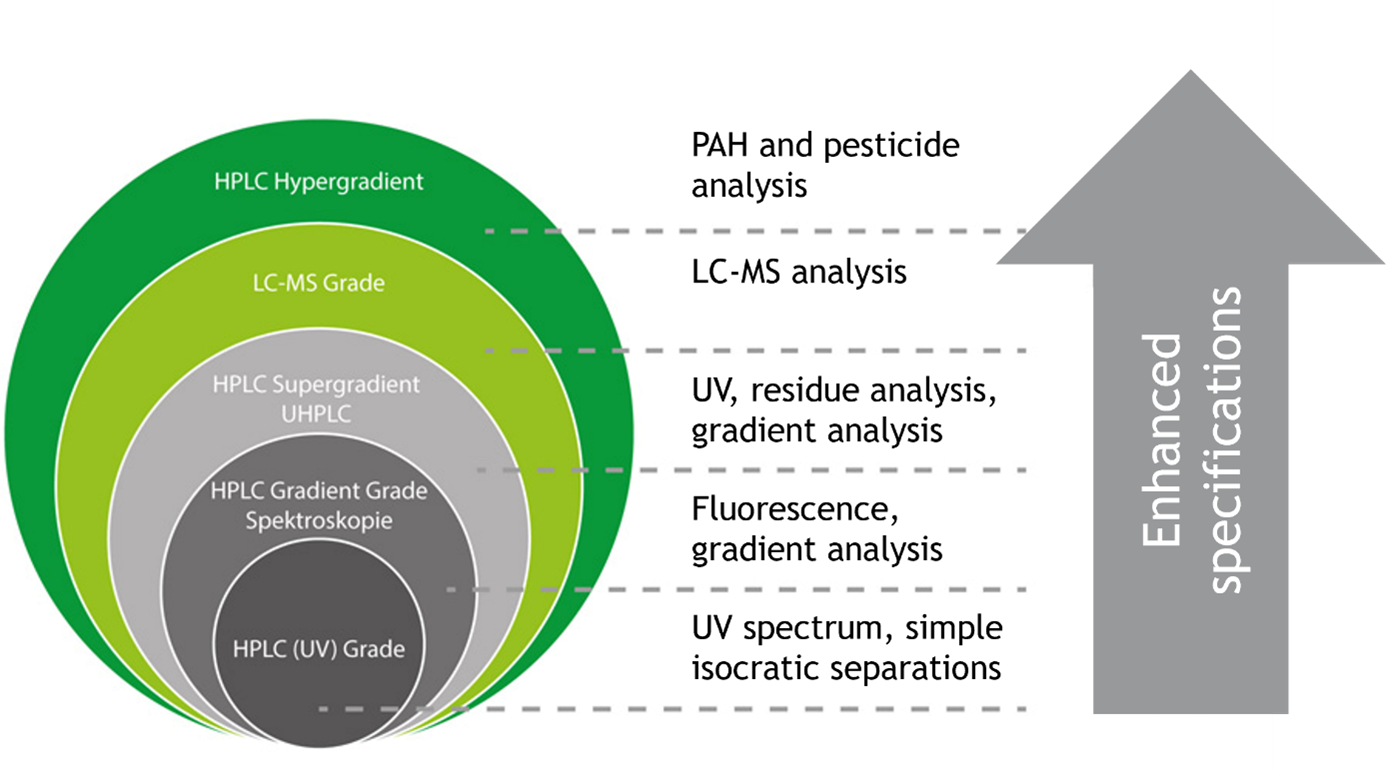
Solvents for high-performance liquid chromatography (HPLC), source:
ITW Reagents, PanReac AppliChem
Reagents for gas chromatography (GC)
Reagents for gas chromatography are specially developed for use in gas chromatographs. Depending on the application, different detectors are also used (ECD, FID or MS). All solvents are microfiltered (0.2 µm) and filled in a nitrogen atmosphere.
| Grade | Description |
| For pesticide analysis using GC | Reagents for analyzing pesticide residues in the food industry and in environmental protection. Carefully controlled by GC-ECD and GC-FID. |
| For headspace GC | Solvents for use in headspace GC. Solvent with maximum purity for use in the preparation of samples for subsequent analysis by headspace gas chromatography. For the control of solvent residues in pharmaceuticals (according to Ph. Eur. and USP). |
| Derivatization reagents | Reagents for gas chromatography to derivatize other compounds to improve their volatility, thermal stability or detection limit by GC detectors. |
Reagents for atomic spectroscopy
High purity reagents for trace metal analysis in environmental laboratories, quality laboratories and research laboratories.
| Grade | Description |
| For analysis, low mercury content | Acids with particularly low mercury content. Suitable for mercury determination using the AAS cold vapor technique. |
| For AAS | Acids with particularly low metal content.Suitable for analyzing heavy metals and other elements in the ppm range. More than 30 metals are specified. In most cases the content is below 0.005 ppm (mg/L). |
| For trace metalanalysis (ppb) | Acids with a very low metal content. Suitable for analyzing heavy metals and other elements in the ppm range. More than 60 metals are specified. In most cases, the content is below 0.1 ppb (μg/L). |
| For trace metalanalysis (ppt) | Acids with a very low metal content. Suitable for analyzing heavy metals and other elements in the ppm range. More than 60 metals are specified. In most cases the content is below 10 ppt (ng/L). |
Conclusion
This two-part article provides a brief overview of the importance of chemical qualities, purities and specifications.
- The difference between regulated and non-regulated specifications was clearly worked out and presented.
- In addition, a brief overview of the possible uses of chemicals depending on the degree of purity was presented.
- Finally, the customer is always advised to compare the specifications to guarantee ‘fitness for the (analytical) purpose’.
Here it is often worthwhile to go for the higher quality to save working time and thus also costs for time-consuming and demotivating repetitions of tests. In most cases, the labor costs for test repetitions are higher than the costs for high-quality chemicals.
This article should end as it began - with musical titles.
Appropriate to the end is R.E.M.'s “It's the end of the world as we know it” (R.E.M., “Document”, 1987) and of course Alanis Morissette's “Thank you” (Alanis Morissette, “Supposed Former Infatuation Junkie”, 1998) for your constant reading until the end of this article.
Thank you!
This blog entry was provided by Jens Boertz, AppliChem, February 2025.
Missed part one? Find it here.