
Vitamin D Mangel: Prävention, Diagnose und Therapie
- 14 Minutes to read
- Written by Sven Skinner-Canetti
- Pharmacy
Vitamin D value determination with the Rapi-D Cube Reader
- High-quality 25-OH vitamin D test, identical to the medical diagnosis
- Measuring range from 3 ng/ml (7.5 nmol/L) to 100 ng/ml (250 nmol/L)
- 100% specificity
- 25 tests per pack - can be stored at room temperature
- Ideal monitoring of the values
- Small blood volume of only 10 μl capillary blood from the fingertip
- Measurement result after just 15 minutes
- Quality control material available separately


Why does the body need vitamin D?
Vitamin D is responsible for the absorption of calcium and phosphate from the intestine and regulates calcium and phosphate metabolism. It therefore plays an important role in bone and tooth formation. Recent scientific findings indicate that vitamin D is not only important for bone health, but also for the entire musculoskeletal system, especially the muscles. It is also being discussed whether vitamin D has a protective function in cardiovascular diseases, cancer, neurological diseases, autoimmune diseases and infections. However, the question of cause and effect is controversial, which is why no clear statement can be made at present.
Occurrence and absorption of vitamin D
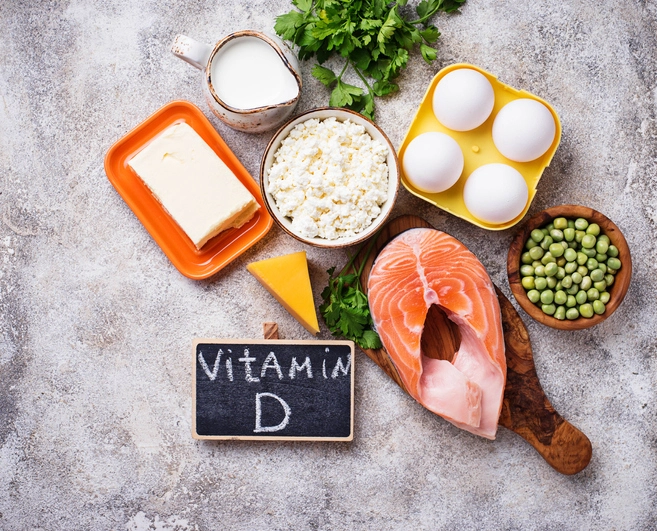
The vitamin D content in food is rather low. It is mainly found in fatty fish, chicken eggs and edible mushrooms. In Switzerland, vitamin D may be added to foods. One example of this is vitamin D-enriched margarine. The addition of a maximum of 5 µg (equivalent to 200 international units) in a daily dose is permitted. The fat-soluble vitamin D is a special case among the vitamins. This is because it can be formed in the human skin when it is exposed to the sun. The vitamin D formed in the skin contributes to approx. 80-90% of the vitamin D supply. The remaining 10-20% comes from food. Both the vitamin D ingested with food (vitamin D2 and D3) and the vitamin D3 formed in the skin are first changed in the liver to calcidiol (25-hydroxy vitamin D) and then in the kidneys to calcitriol (1,25-dihydroxy vitamin D) (Figure 1). Only this modified form (calcitriol) is active and can perform the functions of vitamin D.
What influences vitamin D production?
Various factors have an influence on the extent of vitamin D production in the skin. People with a stronger skin pigmentation have a lower vitamin D production in the skin than people with a lighter skin type with the same amount of sunlight. In our latitudes, vitamin D deficiency is therefore more common in these people.
In our latitudes, solar radiation in winter is too low to produce sufficient vitamin D in the human skin. This also applies to sunny days in the lowlands and in the mountains. In winter and on colder days, the skin is usually covered by clothing. On a typical Swiss summer day in July, however, the skin of the face and hands produces 600 IU of vitamin D when exposed to the sun for around 20 minutes. These seasonal differences lead to seasonal fluctuations in the vitamin D concentration in the blood. In spring until the end of summer, the vitamin D concentration rises and vitamin D is stored in fatty tissue. In the fall/winter, these stores are depleted and the vitamin D concentration subsequently decreases.
The length of time the skin is exposed to the sun also plays a role. People who spend a lot of time outdoors have more opportunity to produce vitamin D than those who spend most of their time indoors. In summer, the sun is so strong that the skin only needs to be exposed to the sun for a short time (face and hands approx. 20 minutes) for sufficient vitamin D production.
The skin's ability to produce vitamin D decreases with age. Older people are therefore increasingly dependent on vitamin D intake from food. In addition, older people (especially the very old and those in need of care) sometimes spend less time or less time outdoors for various reasons and have less vitamin D synthesis due to reduced sun exposure.
The use of sun protection reduces the body's own vitamin D production in the skin. However, sun protection should not be dispensed with when spending long periods in the sun, as intensive sunbathing leads to sunburn and, in the long term, to premature skin ageing and a higher risk of skin cancer.
Taking certain medications (e.g. some cholesterol-lowering drugs, anti-fungal agents, cortisone, anti-seizure medication) increases the risk of vitamin D deficiency. Certain illnesses (e.g. chronic liver and kidney diseases, gluten intolerance (coeliac disease) or chronic inflammatory bowel diseases such as Crohn's disease) can also have an impact on the vitamin D supply. Affected persons should discuss this topic with their doctor.
What happens with a vitamin D deficiency?
A vitamin D deficiency occurs when the body's own vitamin D production in the skin and/or the intake of vitamin D through food is too low, vitamin D is not absorbed in the intestine or the necessary conversions in the liver or kidneys to calcidiol or calcitriol do not take place.
A severe vitamin D deficiency in infants and young children can lead to rickets. Rickets manifests itself in the form of skeletal deformities, as the mineralization of the bones is disturbed. In adulthood, a severe vitamin D deficiency leads to osteomalacia (softening of the bones). As in infancy and early childhood, this results in insufficient incorporation of calcium and phosphate into the bones. An inadequate supply of vitamin D also promotes the development of osteoporosis (bone fragility), as less calcium is absorbed from the intestine due to the vitamin D deficiency and more calcium is broken down from the bones. Adults with a vitamin D deficiency may exhibit the following symptoms: Bone or muscle pain, muscle weakness, general fatigue. In summer, the vast majority (80%) of the Swiss population is sufficiently supplied with vitamin D. In winter, however, more than 60% of the population is deficient or has a serum value [25(OH)D concentration] below the recommended value of 50 nmol/l.

Fig. 1 International staging of vitamin D supply
Vitamin D supplements: does it make sense to take them?
In the winter months in particular, it is difficult to maintain vitamin D levels at a sufficiently high level. As sun exposure is not sufficient and the need for vitamin D cannot be covered by diet alone, it may be advisable to take vitamin D in the form of supplements.1
Who should take vitamin D tablets?
Taking vitamin D as a dietary supplement can be useful:
- in the case of a proven vitamin D deficiency
- to maintain a normal vitamin D level in the blood
- or the prevention of osteoporosis (bone loss)
- for older people to prevent osteoporosis
- with a tendency to depression
- for children to prevent rickets
- for people with high blood pressure
- for the prevention of cancers such as breast cancer, kidney cancer or bowel cancer
- for the prevention and treatment of respiratory tract infections
- preventive against autoimmune diseases 1
Vitamin D overdose
An overdose of vitamin D cannot occur naturally - i.e. neither through excessive exposure to the sun nor through eating plenty of foods that naturally contain a lot of vitamin D (such as fatty sea fish). 2
An oversupply is (theoretically) possible by taking high doses of food supplements or vitamin D preparations.
An overdose of vitamin D can trigger various health problems, which are mainly due to an increased calcium level in the blood (hypercalcemia): the excess vitamin D causes the body to absorb an excessive amount of calcium from food and also to release more calcium from the bones. Via this mechanism, an overdose of vitamin D can lead to cardiac arrhythmia, weakness, fatigue, headaches, nausea, vomiting and impaired consciousness, among other things. In severe cases, kidney stones and kidney failure or even death can occur.
Effects of the lockdown on vitamin D status
In view of the unclear infectiological developments, a good vitamin D supply for the population is undoubtedly advisable from a public health perspective. A new, third lockdown is also likely to have a negative impact on the vitamin D status of the population. 3
Sources and references:
- VitaminExpress 18.03.2021
- FSVO website - Vitamin D deficiency: Data situation, safety and recommendations for the Swiss population (2012): Report of the Federal Commission for Nutrition EEK - Recommendations on vitamin D: Federal Food Safety and Veterinary Office FSVO - Questions and answers on vitamin D: Federal Food Safety and Veterinary Office FSVO
- Lanham-New SA, Webb AR, Cashman KD, et al. Vitamin D und SARS-CoV-2-Virus/COVID-19-Erkrankung. BMJ Nutrition, Prevention & Health 2020; 0. doi:10.1136/ bmjnph-2020-000089