

Evolving Thyroglobulin Diagnostics: Precision, Interference Control, and Modern CLIA Processes in the Follow-Up Care of Thyroid Cancer
- 5.5 Minutes to read
- Written by Axonlab
- Hospital
From Single-Point Diagnostics to Intelligent Long-Term Monitoring
Follow-up care for differentiated thyroid carcinoma has traditionally relied on thyroglobulin (Tg) as the key molecule for detecting residual tissue and tumor recurrence after thyroidectomy [1]. However, recent findings highlight that the diagnostic value of this parameter does not lie in a static single value. Rather, the focus is shifting toward interference control, strict standardization of measurement procedures, and, above all, the evaluation of longitudinal trends [2,3].
Modern chemiluminescence immunoassays (CLIA) now offer analytical sensitivity that significantly surpasses earlier technologies. They are the key to reproducible results at high sample throughput and, due to their high functional sensitivity, increasingly reduce the need for time-consuming stimulation tests (e.g., with rhTSH) [4].
The silent confounding factor: anti-thyroglobulin antibodies
Background and methodological shift
Anti-thyroglobulin antibodies (TgAb) can significantly skew Tg measurements. In the classic sandwich assay, they bind to the Tg molecule and sterically block recognition by the assay antibodies [5]. The consequence: falsely low Tg levels despite potential tumor activity.
While imprecise recovery tests were frequently used in the past, direct, highly sensitive quantitative TgAb measurement is now considered the gold standard for interference testing.
Clinical Relevance Figure 1: Mechanism of TgAb Interference in the Sandwich Assay
- Prevalence: TgAb are present in a significant proportion of patients (~10–25%) [6].
- Validity: Their presence drastically reduces the diagnostic reliability of the quantitative Tg value [2].
- Guideline compliance: International guidelines (ATA, ETA) require: Tg and TgAb must be determined simultaneously from the same sample [3].
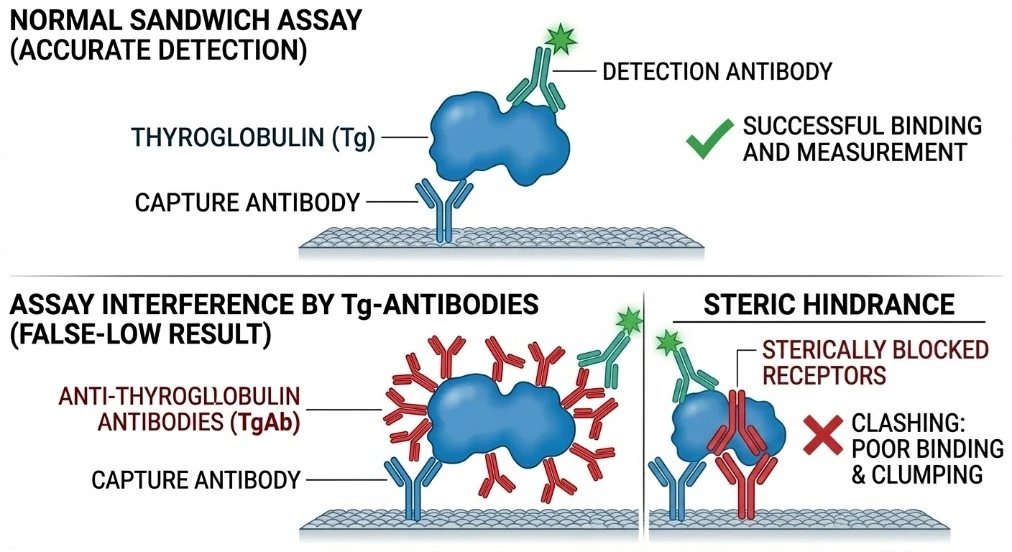
Fig. 1: Schematic representation of thyroglobulin determination. Top: Uninterrupted CLIA with correct formation of the antibody-antigen complex. Bottom: Interference by TgAb. The patient’s own antibodies occupy the epitopes (steric hindrance), prevent binding of the detection antibody, and lead to falsely low results.
Source: Created with AI support (Google Gemini 3 Flash), 2026 [11].
Dynamic biomarkers instead of single values
Modern follow-up care is moving away from isolated interpretations—toward dynamic monitoring of disease progression [1,7]. In this context, “Tg velocity” (rate of change) is often more meaningful than the absolute concentration.
Key parameters for assessing disease progression: Figure 2: Dynamics of thyroglobulin progression
- Tg trend: Monitoring over months and years under stable TSH suppression.
- Tg kinetics: Early detection of relapses through trend breaks (increases beyond the analytical variance).
- TgAb monitoring: A decrease in antibody titers is often a sign of remission, while rising titers indicate residual antigen.
- Risk adaptation: Intervals of 3–6 months in high-risk patients allow for rapid intervention [9].
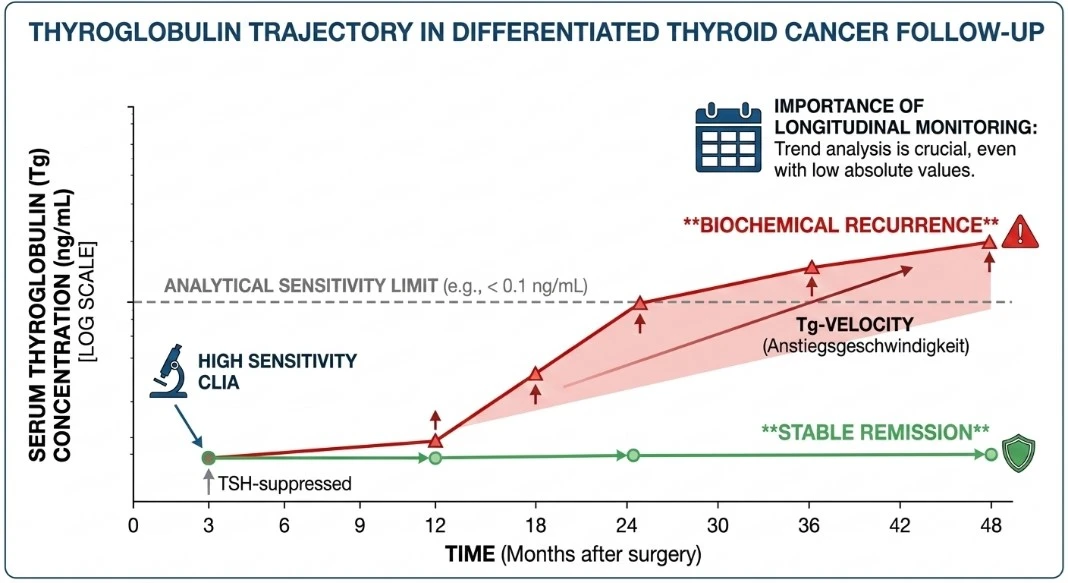
Fig. 2: Longitudinal monitoring. The green curve shows stable remission (values consistently below the detection limit). The red curve illustrates a biochemical recurrence: Despite initially low values, a significant break in the trend is evident. Tg velocity enables the detection of tumor activity before clinical symptoms appear.
Source: Created with AI support (Google Gemini 3 Flash), 2026 [11].
Modern CLIA Systems: Precision & Process Quality
In addition to analytical sensitivity, the focus is shifting to the robustness of the laboratory system. Modern CLIA platforms minimize sources of technical error, such as the hook effect, through intelligent assay design and automated dilution protocols [4].
Advantages of modern CLIA platforms: Future prospects
- Automation: Minimization of manual sources of error.
- Standardization: Use of magnetic microparticles for high signal stability.
- Reproducibility: Ensuring comparable results over long periods—essential for assessing disease progression.
- Digital connectivity: Integration into LIS for automated plausibility checks.
The future of Tg diagnostics is shaped by the symbiosis of high-performance chemistry and data analysis:
- Algorithmic evaluation: Software-supported analysis of longitudinal trends.
- AI integration: Linking Tg trends with imaging modalities for individual risk profiles.
- Expanded panels: Simultaneous measurement of additional markers on the same platform.
References
- Haugen BR et al. ATA Guidelines. Thyroid. 2016;26(1):1-133.
- Spencer C, Fatemi S. TgAb methods. Best Pract Res Clin Endocrinol Metab. 2013;27(5):701-712.
- Giovanella L et al. High sensitive Tg assays. Eur J Endocrinol. 2014;171(2):R33-R46.
- Algeciras-Schimnich A. Tg measurement. Crit Rev Clin Lab Sci. 2018;55(3):205-218.
- Spencer CA. Assay of Thyroid Hormones. Endotext. 2021.
- Spencer CA. TgAb measurements. J Clin Endocrinol Metab. 2011;96(12):3615-3627.
- Netzel BC et al. Elecsys Tg II Assay. Clin Chem. 2020;66(3):422-431.
- Lamartina L et al. Importance of Trend. Curr Med Chem. 2018;25(35):4496-4503.
- Perros P et al. Management of thyroid cancer. Clin Endocrinol. 2014;81:1-122.
- Tuttle RM et al. Differentiated Carcinoma. Endotext. 2000-.
- Google Gemini. Modellierung der Tg-Kinetik und Interferenzmechanismen. [Generative KI-Illustration]. 2026.