

Feeling tired in the summer? When to consider your thyroid – and what lab tests can reveal
- 17.5 Minutes to read
- Written by Kristina Airich
- Hospital
From nonspecific symptoms to a clear diagnosis

Tired, unable to concentrate, and weight fluctuations. In the summer, such symptoms are often quickly attributed to the heat or pollen. But sometimes the thyroid is to blame. A European meta-analysis shows that about one in twelve adults has hypothyroidism, and nearly half of those cases remain undiagnosed [1]. In general practice, the key question remains: When is a TSH level alone sufficient, and when is more needed? And what does that mean for the laboratory behind it?
This is how often the thyroid is affected
Thyroid disorders are among the most common endocrine disorders in Europe [1]. In practice, two conditions dominate: hypothyroidism, whether overt or subclinical and usually caused by Hashimoto’s thyroiditis, and the significantly rarer hyperthyroidism, often presenting as Graves’ disease or functional autonomy. This article focuses on the more common routine management of hypothyroidism.
TSH first – what the guidelines say
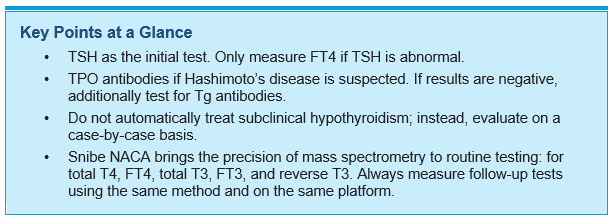
The Swiss Society of Endocrinology and Diabetology (SGED), the European Thyroid Association (ETA), and the American Thyroid Association (ATA) agree: TSH should be the initial test [2, 3, 4]. Why? TSH reacts to even the slightest changes in peripheral thyroid hormones with marked changes, much more strongly than the hormone levels FT3 and FT4 themselves change. A mild dysfunction thus becomes apparent earlier in the TSH than in the peripheral hormones.
This leads to a clear sequence: TSH first, and in most cases that is sufficient [2, 8]. FT4 (and less commonly FT3) is measured as a supplement when TSH is abnormal (to assess severity and direction) [3, 4], during pregnancy [9], when central hypothyroidism is suspected [10], or during ongoing levothyroxine therapy [4]. How reliably both parameters can be measured in routine practice – TSH as a sensitive screener and FT4 as a supplementary test – depends on the underlying analytical methods. Much has changed in this area over the past two decades.
CLIA: The current standard and its limitations
Chemiluminescent immunoassays (CLIA) are the current standard method for thyroid diagnostics. Over the past two decades, they have completely replaced the radioimmunoassays previously in use and have become significantly more accurate and reproducible analytically.
The core of modern CLIA is the sandwich principle: two monoclonal antibodies bind the analyte from two sides. The first captures it, while the second carries a marker that emits a luminescent signal upon activation. The light intensity correlates directly with the analyte concentration. For TSH, thyroglobulin (Tg), TPO antibodies, and Tg antibodies, this is a very precise method; the routine thyroid panel from major manufacturers is almost entirely based on this design.
Mass spectrometry remains the analytical gold standard for free thyroid hormones, typically liquid chromatography coupled with tandem mass spectrometry (LC-MS/MS), combined with equilibrium dialysis to separate free from bound hormones. However, these methods are too complex and resource-intensive for routine use.
A modern CLIA platform must therefore meet two requirements simultaneously: fast, automated processing within the routine workflow and analytical reliability comparable to mass spectrometry.
This is now well addressed for TSH. Third-generation TSH tests – a classification established throughout laboratory medicine and not manufacturer-specific – achieve a functional sensitivity of ≤ 0.01 mU/L. This is about 100 times more sensitive than the first TSH assays from the 1970s. This also allows for the clear delineation of subclinical hyperthyroidism – which, unlike hypothyroidism, is primarily detected via suppressed TSH and therefore makes the high lower detection limit clinically useful. This is particularly relevant for older patients, in whom subclinical hyperthyroidism occurs more frequently and increases the risk of atrial fibrillation and osteoporosis.
So much for TSH and thyroid antibodies. When it comes to the free thyroid hormones FT4 and FT3, the analysis gets significantly trickier: they are too small for a classic sandwich method. This is precisely where a real gap in routine immunochemistry has existed for years.
Snibe NACA – Sandwich Precision for Small Molecules
The reason for this gap lies in the physics of the molecules. Both FT4 and FT3 are so small that the classic sandwich principle of an immunoassay does not work. For a sandwich binding, the hormone would need two spatially separate binding sites where two antibodies can dock simultaneously. These simply do not exist in FT3 and FT4.
For this reason, routine testing has measured these small molecules for decades using the competitive method: the analyte to be measured and a labeled tracer compete for the same binding site on the antibody. The result is calculated indirectly from this competition. This works, but is analytically less precise than mass spectrometry. During follow-up monitoring over the course of years, even small methodological shifts (different reagent batch, different manufacturer) can be misinterpreted as clinical changes. This gap has been considered unresolved in routine immunochemistry for small molecules for over twenty years.
It is precisely this gap that the Snibe NACA technology (Noncompetitive Anti-Immune Complex Assay) closes. The principle is cleverly reversed: A first monoclonal antibody binds the hormone. The second antibody then no longer recognizes the hormone itself, but rather the already formed antigen-antibody complex. This creates a true sandwich binding, even without a second binding site on the hormone.
A method comparison for 25-OH vitamin D demonstrates how well this works in practice: a correlation of r = 0.97 with LC-MS/MS mass spectrometry – the reference method for 25-OH vitamin D – in a dataset of 1,309 samples (the maximum possible value is 1.00) [6]. For thyroid parameters, the NACA-based MAGLUMI X series was additionally analytically verified: An independent study confirmed good precision for TSH and values comparable to those of other analyzers; for FT4, the requirements of CLSI EP15-A3 (standard for precision verification) were met. The study authors recommend always measuring free thyroid hormones using the same standardized method for follow-up assessments [5].
NACA covers the full spectrum of thyroid parameters: total T4, free T4, total T3, free T3, and reverse T3 – all on the same platform, all based on the same principle, and calibrated against international reference standards (DEQAS, NIST).
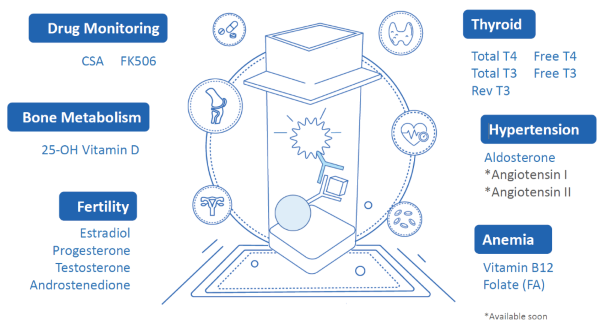
Fig. 1: Snibe-NACA sandwich reaction in the enlarged cuvette of the MAGLUMI® X-Series. With thyroid applications: Total T4, Free T4, Total T3, Free T3, and Reverse T3 (Source: Snibe Diagnostics / Axonlab).
The test results and what they mean
With the methodology in mind, the next question arises: How exactly should the test results be interpreted? In routine practice, three typical scenarios dominate – two classic TSH/FT4 patterns plus the frequent case where the thyroid is ruled out as the cause:
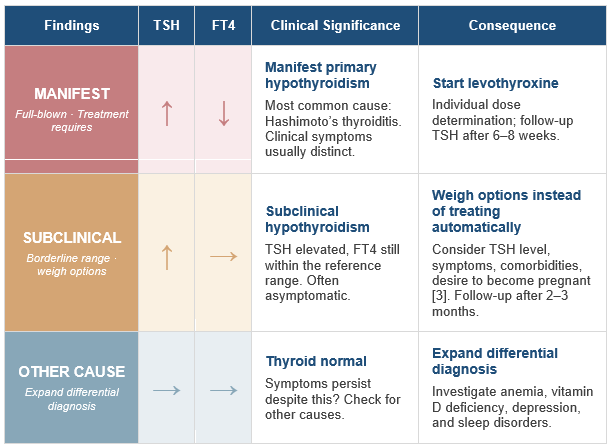
The table shows what TSH and FT4 indicate together. This does not yet clarify the cause: If an autoimmune origin is suspected – most commonly Hashimoto’s thyroiditis – TPO antibodies are the next diagnostic step. They are positive in the majority of patients with Hashimoto’s disease [4].
If the TPO result remains negative and clinical suspicion persists, Tg antibodies can be determined as a supplement – they are isolated positive in a minority of patients with Hashimoto’s disease.
The question remains how this clinical logic can be efficiently reflected in everyday laboratory practice and which platform provides the methodological prerequisites for this.
In the laboratory: Reflex strategy and consolidation
The reflex strategy has become established in many Swiss laboratories. The laboratory information system (LIS) starts with TSH as the first test. If the value is within the reference range, the diagnosis is complete in most cases. If it is pathological, the system automatically requests an FT4 measurement from the same sample without requiring a new sample run. FT3 is only added in specific situations – such as in cases of suppressed TSH to investigate T3 hyperthyroidism or during levothyroxine combination therapy. This saves reagents, reduces processing time, and aligns with the Choosing Wisely recommendations for thyroid diagnostics [8].
For long-term follow-up over several years, typical in Hashimoto’s disease or in cancer aftercare, the following methodological rule also applies: measurements should be performed on the same platform and using the same method whenever possible, so that technical shifts are not misinterpreted as clinical changes.
To integrate the reflex strategy and NACA methodology into daily routine, a platform is needed that can do both: manage the workflow and provide methodologically non-competitive measurement of free hormones. Currently, this applies to exactly one platform on the market: the MAGLUMI X series from Snibe Diagnostics. NACA is a proprietary development by Snibe and is available exclusively on this series; other manufacturers continue to use the competitive method in routine practice.
Beyond the NACA applications for FT3, FT4, Total T3, Total T4, and reverse T3, the platform is broadly designed: over 260 CLIA parameters from endocrinology, reproductive medicine, oncology, cardiology, bone metabolism, infectious disease serology, autoimmune diagnostics, and therapeutic drug monitoring. The thyroid panel (TSH, FT3, FT4, TPO-Ab, as well as thyroglobulin Tg and Tg-Ab as tumor markers in cancer follow-up) is one of many diagnostic areas covered by it. For the laboratory, this means a consolidated methodology: one workflow, one quality management system, one training concept. The series scales from a compact entry-level system (X3) to high-throughput configurations for central laboratories (X10).
For laboratories that provide long-term follow-up care for patients with thyroid carcinoma, this consolidation is particularly valuable: Tg and Tg-Ab are measured on the same platform and, ideally, from the same sample.
The NACA methodology described here and the associated platform strategy will also be presented live and discussed with international experts:

So much for the analytical and operational aspects. What does all this mean for patient care?
From symptoms to a reliable diagnosis
In cases of symptoms such as those described at the outset – namely fatigue, difficulty concentrating, or weight fluctuations – the primary clinical question is: Is there thyroid dysfunction, or should the differential diagnosis be expanded? A methodologically sound TSH measurement usually answers this in most cases. Diagnostics only become truly challenging where the course of the disease matters: in Hashimoto’s patients over the course of years, in post-thyroidectomy cancer follow-up, or in cases of subclinical findings that require individualized decisions. Diagnostic monitoring relies on the fact that a change in values reflects the patient’s condition, not the method. For the small molecules FT4 and FT3, this is now achievable for the first time in routine practice using non-competitive NACA technology – and for the patient, this means fewer unnecessary therapy changes and greater confidence in the course of treatment.
Would you like to test the complete thyroid panel on the MAGLUMI X-Series?
Request a data sheet for the consolidated thyroid panel (TSH, FT3, FT4, TPO-Ab, Tg, Tg-Ab using Snibe-NACA technology) or schedule a demo on MAGLUMI X3 / X6
→ marketing@axonlab.com
FAQ
▸ How does subclinical hypothyroidism differ from overt hypothyroidism?
Subclinical: Elevated TSH, FT4 still normal. Manifest: Elevated TSH, decreased FT4. In the manifest form, the indication for therapy is clear; in the subclinical form, decisions are made on an individual basis, depending on TSH levels, symptoms, and comorbidities.
▸ What is Snibe NACA technology and why is it relevant for the thyroid?
NACA (Noncompetitive Anti-Immune Complex Assay) is the first non-competitive sandwich technology for small molecules in routine CLIA. For total T4, FT4, total T3, FT3, and reverse T3, it provides precision on par with mass spectrometry.
▸ When should thyroid antibodies be tested?
In cases of abnormal TSH for Hashimoto’s evaluation, test TPO antibodies first; if TPO results are negative and clinical suspicion persists, supplement with Tg antibodies. Additional indications: diffuse or nodular goiter, desire to conceive, and early pregnancy.
▸ What do elevated TPO antibodies mean when TSH is within normal limits?
Indicative of subclinical autoimmune thyroiditis. Follow-up every 12 months is recommended [4].
▸ What can the MAGLUMI X series do beyond thyroid testing?
The MAGLUMI X series comprises over 260 CLIA parameters in endocrinology, reproductive medicine, oncology, cardiology, bone metabolism, infectious disease serology, autoimmune diagnostics, and therapeutic drug monitoring. The thyroid panel is just one of them; the platform covers the entire routine and specialty menu of a medium- to large-sized laboratory.
Literatur
- Garmendia Madariaga A et al. The incidence and prevalence of thyroid dysfunction in Europe: a meta-analysis. J Clin Endocrinol Metab. 2014;99(3):923–931. PubMed: 24423323.
- Schweizerische Gesellschaft für Endokrinologie und Diabetologie (SGED-SSED) / Smarter Medicine — Choosing Wisely Schweiz. Empfehlungen zur Schilddrüsendiagnostik. www.sgedssed.ch
- Pearce SHS et al. 2013 ETA Guideline: Management of Subclinical Hypothyroidism. Eur Thyroid J. 2013;2(4):215–228.
- Jonklaas J et al. Guidelines for the Treatment of Hypothyroidism (ATA). Thyroid. 2014;24(12):1670–1751.
- Deniz L et al. Analytical Verification and Method Comparison of the Maglumi X8 for Thyroid Function Tests. Clin Chem Lab Med. 2025. PubMed: 40387742.
- Evaluation of automated SNIBE Vitamin D immunoassay for 25-OH vitamin D: Comparison with LC-MS/MS (Abstract B-011). Clin Chem. 2025;71(Suppl 1):hvaf086.410.
- Snibe Diagnostics / Axon Lab. Snibe-NACA – die einzige nicht-kompetitive Sandwich-Technologie für Small Molecules. Trillium-Flyer MAGLUMI X-Serie (PDF, Mai 2026).
- Smarter Medicine — Choosing Wisely Schweiz. Top-5-Empfehlungen der SGED-SSED in Endokrinologie und Diabetologie. www.smartermedicine.ch
- Alexander EK et al. 2017 Guidelines of the American Thyroid Association for the Diagnosis and Management of Thyroid Disease During Pregnancy and the Postpartum. Thyroid. 2017;27(3):315–389. PubMed: 28056690.
- Persani L et al. 2018 European Thyroid Association (ETA) Guidelines on the Diagnosis and Management of Central Hypothyroidism. Eur Thyroid J. 2018;7(5):225–237. PubMed: 30374425.