

Optimising Your Clinic’s Laboratory: Instrument Positioning and Processes That Improve Diagnostics
- 6 Minutes to read
- Written by Axonlab
- General Practice
In most medical laboratories, the locations of lab instruments are fixed. But does that really make sense? Have their locations been optimised for your workflows? After reading this article, you’ll be able to judge whether your diagnostic instruments are in their ideal locations and how you can design efficient workflows – from sampling to results.
You draw blood from a patient at their check-up and first run those analyses, like INR, that are performed on capillary blood. After placing the test tubes (other than the serum samples) on the mixer, you wonder which analyses are the most important and which ones will take the most time. Always start with the most important analyses, such as troponin and D-dimer, and with samples for whole-blood analysis.
If you don’t need any analyses from heparin whole blood, you can go ahead and centrifuge it. An especially efficient approach is to place the heparin whole blood in the centrifuge even while your patient is still applying pressure to the blood draw site. That way, the centrifuge will already be running as you apply the bandage or dressing and send the patient on their way.
In the meantime, we recommend carrying out all of the analyses that are to be performed on the same sample, e.g., a blood count, CRP and HbA1c from an EDTA sample. Having the corresponding analysers positioned next to each other makes sense here. The mixer should be near the instruments that will be used for analysing mixed samples. The centrifuge should likewise be positioned near the clinical chemistry instrument to keep its vibrations from interfering with other measurements.
The next step is to run both the urinalysis and the test for microalbumin in the urine so that you will only need to mix the urine once. You can follow that with additional analyses, such as blood sedimentation, BNP and rapid tests.
Did you know that the waste products of most haematology analysers go right down the drain? For that to work, your haematology analyser needs to be positioned near a sink or other connection to the wastewater system. Ideally, your urine analyser should be located next to the sink too.
Do you have a large laboratory with considerable space between instruments? Make sure that all of the instruments you need for your workflow are right at hand. If your space is limited, Axonlab offers space-saving hybrid units and optimisation solutions, such as our Plexiglas equipment holder, which we have used for optimising many labs.
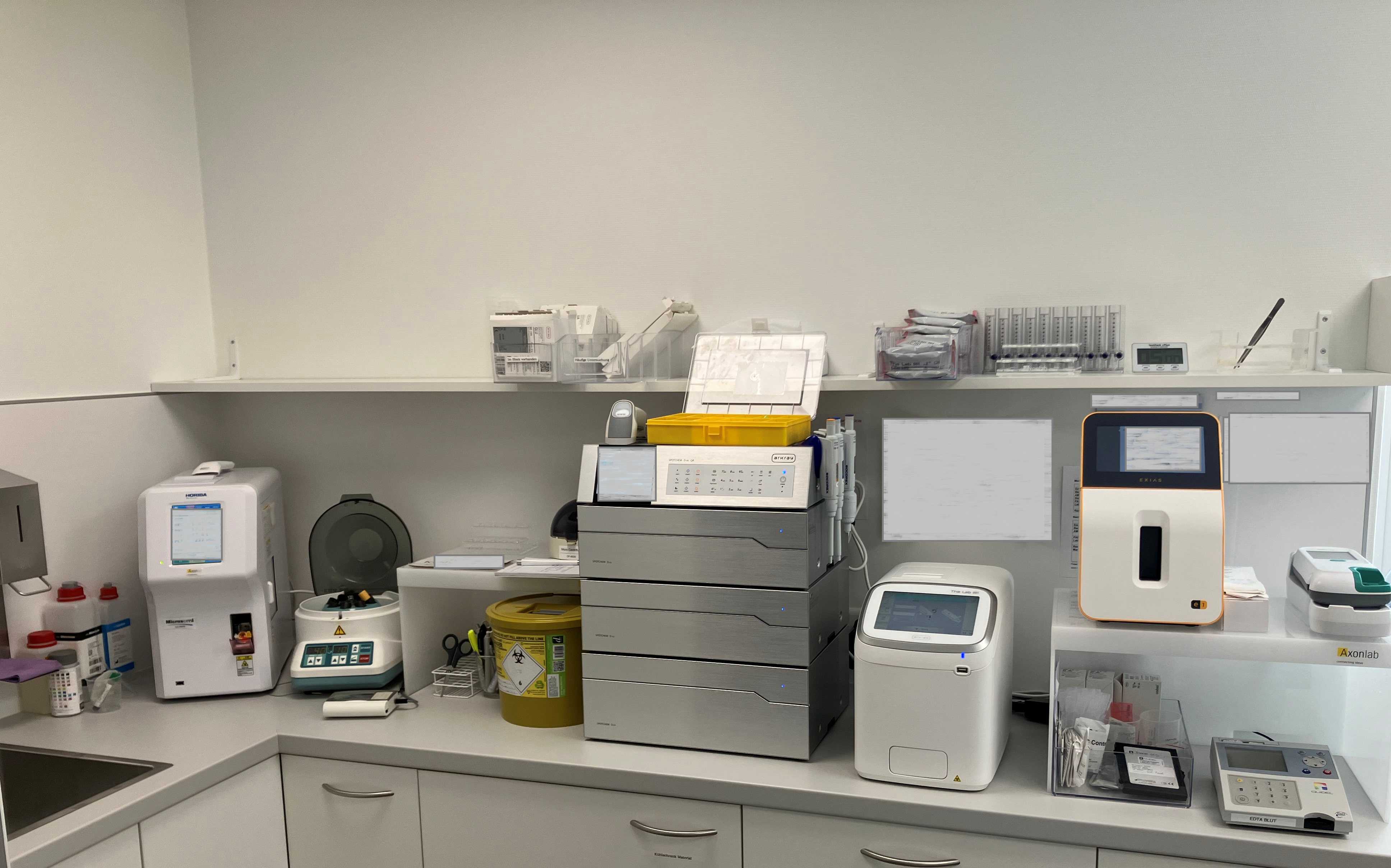
Now that we’ve optimised your workflows and laboratory layout, we still need to remember that regulations differ from one of Switzerland’s official cantonal pharmacists to another. One example here is the use of colour-coding to divide up a lab into green, yellow and red areas.
Axonlab offers a wide range of options tailored to your needs for every billable analysis on the Analysis List issued by Switzerland’s Federal Office of Public Health. Our sales representatives view themselves as customer support agents and not simply as sales employees. After all, we advise our customers and recommend analytical systems from our comprehensive portfolio that make sense for you, for your workflows and for the physical layout of your lab – not to mention instruments of outstanding quality.
That means, of course, that numerous analyses can be run at equally high levels of quality by more than just one instrument. After all, the various measurement principles involved have their limitations depending on the analysis at hand. Whereas cardiac values provide good results, for example, HbA1c can vary greatly on the same analytical system operating according to the same measurement principle.