

Outstanding women scientists: A retrospective and insight into the inventions of women in today's Med Tech industry.
- 9 Minutes to read
- Written by Axonlab
- Corporate
Marie Curie is probably a well-known name to a large number of people. Together with her husband Pierre Curie, she was awarded the Nobel Prize for Physics and Chemistry for the discovery of the chemical elements polonium and radium. A look into the past shows that many other women played an important role in research and science. But they are not all as well known as Marie Curie. On the occasion of International Women's Day, we want to change that and put three of them in the spotlight.
Fanny Angelina Hesse (1850 - 1934): The woman who made microbiology possible
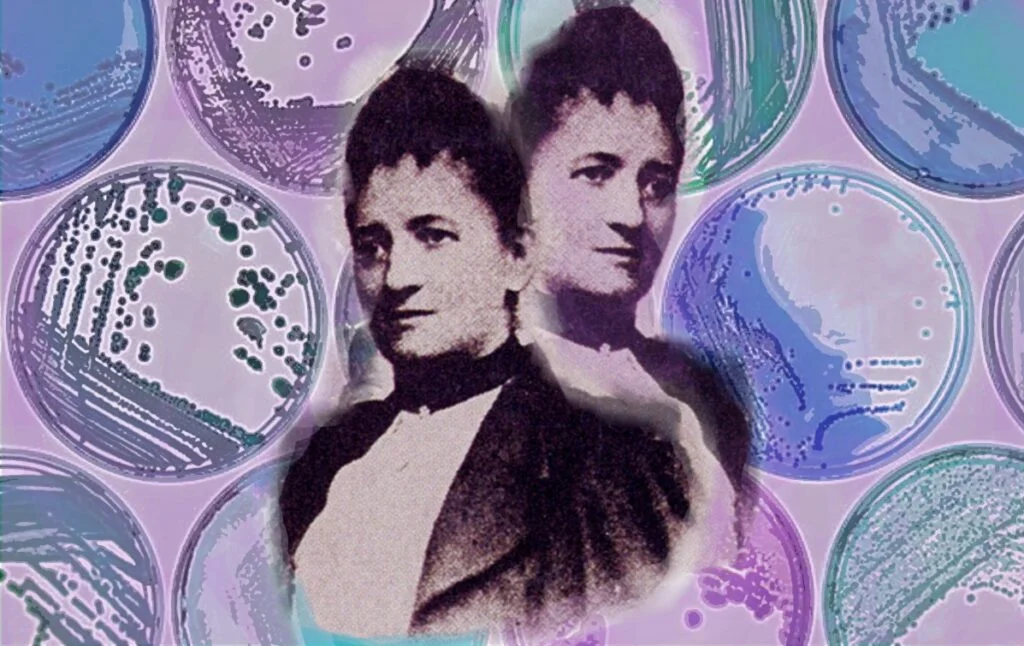
Collage by Fruzsina Eördögh; Petri dish image © M J Richardson (CC BY-SA 2.0
Daughter of a German-American and a Swiss, she is the inventor of the pioneering use of agar-agar as a gelling agent for bacterial culture media. A brief story follows of how the future is being written through lunch conversations and intercultural exchange.
In 1882, German physician and microbiologist Robert Koch discovers the causative agent of tuberculosis. What he lacks, however, is the right culture medium to isolate, identify and classify the bacteria. Attempts with meat broth or with thin potato slices fail. Either the bacteria melt at high temperatures or enzymes are formed that break down the gelatine.
Walther Hesse works in Robert Koch's laboratory from 1881 to 1882, but returns to his own small laboratory after six months in Berlin. His wife Fanny works in the family laboratory as a laboratory assistant and illustrator. One day at lunch, Walther Hesse talks to his wife about the problem with the missing culture medium. During the conversation, the two come to talk about Fanny's pudding, which sticks even when the temperatures outside are warm. The reason for this is the algae product agar-agar, which is used to make the pudding. Fanny, who grew up in New York, learned about the use of agar-agar there from a Dutch neighbour. In Indonesia, where the neighbour had emigrated from, it was common to use agar-agar in cooking. Fanny suggests trying out the gelling agent from Java in the laboratory as well.
Walther Hesse immediately informs Robert Koch of his wife's discovery. As it turns out, agar-agar proves to be an ideal gelling agent that remains solid in the incubator even at higher temperatures and cannot be digested by any bacterial enzyme.
From then on, agar-agar is used to cultivate the bacteria that cause tuberculosis in Robert Koch's laboratory. In a publication on tuberculosis bacteria in 1882, Robert Koch mentions the use of agar-agar instead of gelatine, but the originator of the idea, Fanny Hesse, or her husband are not mentioned. Fanny and Walther Hesse were never rewarded monetarily for the discovery, nor were they mentioned in the scientific literature.
Rosalind Franklin (1920 - 1958): The discovery of the DNA structure
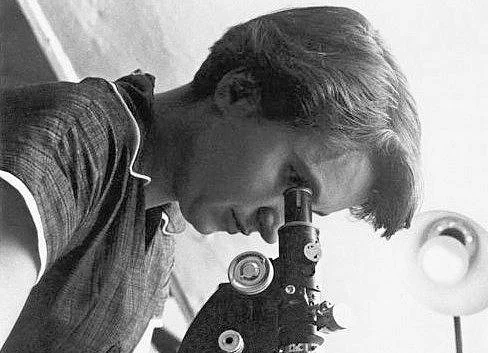
Picture Rosalind Franklin (1955) © CC/MRC Laboratory of Molecular Biology
The British researcher discovered that DNA has a double helix shape. However, the Nobel Prize for Medicine for this discovery did not go to the London-born biochemist, but to the two molecular biologists Francis Crick and James Watson.
In 1950, the decoding of the DNA structure is THE dominant topic in the world of science. Intensive research is being carried out in various laboratories. At King's College London, Rosalind Franklin immerses herself in the examination of a DNA sample with the help of X-rays. She discovers that there are two forms of DNA molecules with different water content and succeeds in producing high-quality images of both forms. Based on these images, she discovers that DNA has the shape of a helix.
Two young men researching in the same field as Franklin at Cambridge University manage to obtain unpublished papers from her and use the research findings without Franklin's permission. The two scientists - James Watson and Francis Crick - draw the right conclusions from Rosalind Franklin's work. After Rosalind Franklin is betrayed by the two men, she leaves both King's College and DNA research and from then on conducts research on the living poliovirus, among other things, at Birbeck College in London.
Rosalind Franklin did not live to see Watson and Crick receive the Nobel Prize for Medicine in 1962 for their discovery of DNA structure. She died of cancer in 1958 at the age of 37 after years of working with X-rays. In obituaries, she is called "a representative of a distinguished line of pioneers who illuminated the structure of nucleoproteins in relation to viral diseases and genetics".
Gertrude Belle Elion (1918 - 1999): The pioneer of chemotherapy
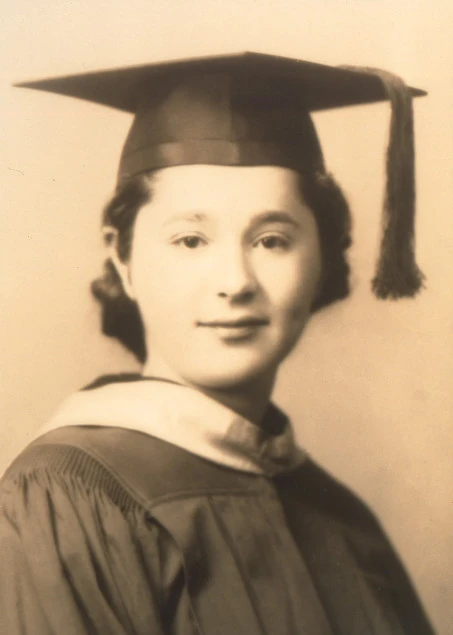
Picture Gertrude Elion's graduation photo from Hunter College, 1937 (credit unknown)
When her grandfather died of stomach cancer, the then 15-year-old American Gertrude Belle Elion decided to become a scientist and find a cure for cancer.
She is the only woman in her semester to study chemistry at New York University (NYU). After completing her studies, she is confronted with the prevailing prejudices against women in science and initially does not find the desired career entry. For the time being, she works as a teacher and in the food industry: "Nobody took me seriously. Everyone asked why I wanted to be a chemist when no other women wanted it. The world was not waiting for me." Due to the labour shortage during World War II, she eventually finds her way into science, starting in 1944 as a laboratory assistant to biochemist George H. Hitchings at the pharmaceutical company Burroughs Wellcome. She will work for the company now known as GlaxoSmithKline for 39 years.
Together with Hitchings, Gertrude Belle Elion makes medical history. For example, they develop the first immunosuppressant, making organ transplants possible. And the determination to find a cure for cancer that had once encouraged Gertrude Belle Elion to persue her career pays off: Together with Hitchings, she develops the first drug to treat leukemia.
In 1988, they both receive the Nobel Prize for Medicine. Today, Gertrude Belle Elion is considered one of the most important drug researchers of the 20th century.
Sources:
- Thiele Susanne (2016): Fannys Rezept - ein Hit für die Mikrobiologie, Onlineportal Mikrobenzirkus, https://mikrobenzirkus.com/2016/02/07/fannys-rezept-ein-hit-fuer-die-mikrobiologie/ [02.03.2023]
- Ricarda Opis (unknown): Rosalind Franklin: Die Mutter der DNA, Onlineportal Welt der Frauen, https://www.welt-der-frauen.at/rosalind-franklin/ [02.03.2023]
- Solvejg Hoffmann (unknown): Zehn Wissenschaftlerinnen, die Sie neben Marie Curie kennen sollten, Onlineportal GEO, https://www.geo.de/wissen/21043-rtkl-weltfrauentag-zehn-wissenschaftlerinnen-die-sie-neben-marie-curie-kennen-sollten [02.03.2023]
- Swantje Koch–Kanz (unknown): Biografie Rosalind Elsie Franklin, Onlineportal Fembio, https://www.fembio.org/biographie.php/frau/biographie/rosalind-franklin/ [02.03.2023]
- Various (2004): Rosalind Franklin, Onlineportal Wikipedia, https://de.wikipedia.org/wiki/Rosalind_Franklin [02.03.2023]
- Dr. Jan Björn Potthast (unknown): Rosalind Franklin, Online Portal Deutsches Patent- und Markenamt, https://www.dpma.de/dpma/veroeffentlichungen/aktuelles/patentefrauen/patentefrauen/rosalindfranklin/index.html [02.03.2023]
- Karin Müller (unknown): Biografie Getrude B. Elion, Onlineportal Fembio, https://www.fembio.org/biographie.php/frau/biographie/gertrude-b.-elion/ [02.03.2023]