

Welcome to the Jungle
- 10 Minutes to read
- Written by Axonlab
- Life Science
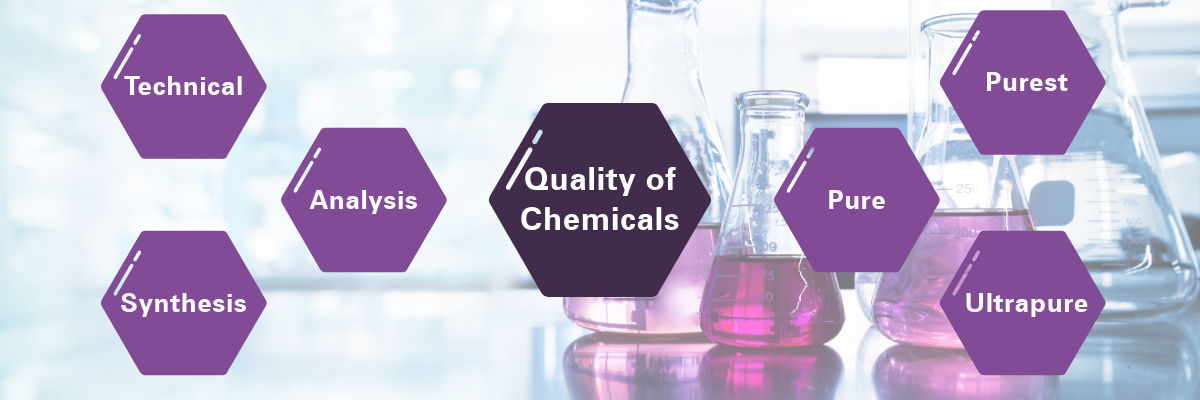
The landscape of chemical grades and specifications
Almost every day, customers contact us to ask for details about chemicals that fall into the categories of grades or specifications. The following article is intended to help every user of chemicals, whether purchaser, laboratory technician, technician, laboratory manager, engineer or chemist, to find their way through the jungle of qualities and specifications and thus better decide which product is best suited for purification, synthesis, analysis, etc.
So let's start here with a few common definitions so that everyone can be taken along on this very interesting journey.
What are chemicals?
Chemicals are chemical substances produced or used industrially or in the laboratory. They can be pure substances or mixtures of substances. However, whether something is labelled as a chemical depends very much on the context. A good example of this would be sodium chloride, which is also commonly known as table salt. In the context of industry and the laboratory, this substance is treated as a chemical, whereas sodium chloride in the supermarket is simply treated as food and is therefore not considered a chemical.
What describes the purity of a chemical?
In chemistry, the purity of substances generally indicates the ratio of a desired substance to the total mixture of substances and is referred to as the mass fraction.
w(x) = m(x)/m(total)*100%
Here, w(x) is the mass fraction of substance x in per cent, m(x) is the mass of substance x in the total mass m(total).
Thus, ‘sodium chloride 98%’ simply means that 100 g of total mass contains the mass of 98 g of sodium chloride, without taking the 2 g of impurities into account.
What is a specification?
The specification of a chemical is understood to mean one or more parameters to be fulfilled by measurement with a limit value or measurement interval.
Such specifications are, for example, a water content of less than 1% or a melting point in the range 65-68 °C.
What is the quality/grade of a chemical?
The quality/grade of a chemical quality is a combination of purities and specifications that (usually) recommend an application.
It is important to emphasize that the user is ultimately responsible for checking the ‘fitness for purpose’ or, in other words, even if a product is recommended for gas chromatography (GC) or high-performance liquid chromatography (HPLC), it may still not be suitable for a specific analysis, as not every potential impurity is and cannot be taken into account (how can this be possible with millions of chemicals?).
A prominent example of this is currently the analysis of polyfluorinated alkyl substances (PFAS) using HPLC-MS/MS. Although specified for HPLC, most HPLC solvents have no data on the PFAS content. Therefore, each user would have to determine this content himself to demonstrate the suitability of the solvent for PFAS analysis (fitness for purpose) or fall back on a manufacturer who offers a suitable solvent with a low, specified PFAS level.
Now that everyone has read and hopefully internalized these basic terms, the next and perhaps much more important question arises:
Are the purity, specifications and qualities of different manufacturers comparable?
To quote another musical highlight after Welcome to the Jungle (Guns ‘n Roses, 1987): “Definitely maybe” (Oasis, 1984)
The specifications of purity depend on the manufacturer and the material. The nomenclature of the qualities is not standardized and can therefore be adapted and/or extended by individual manufacturers. Therefore, a detailed comparison of the specifications on the certificate of analysis and/or the technical data sheet of manufacturers is always useful and should actually be part of the compulsory exercises of all those involved, so that you don't hear again during your daily work: ‘...but I ordered caustic soda for the analysis!’. Dear reader, once again as an urgent reiteration: The chemical from manufacturer 1 and manufacturer 2 can have different specifications with the same quality, which is usually reflected in different mass percentages of impurities (in the small letters on the certificate).
Nevertheless, a basic distinction can be made between six purity levels or quality designations:
1. Technical quality /technical
Technical grade chemicals are products that still contain some impurities but are used exclusively for technical purposes. This is mainly because the degree of purity of the corresponding substances varies. These chemicals are labelled ‘technical’. They are mainly used as cleaning agents in laboratories or in industry.
A little recommendation from the author: Please do not clean your laboratory for ultra-trace analysis with technical products. As a rule of thumb, you are more likely to contaminate your laboratory than clean it. You will probably only increase the blank value of the desired analysis through such a ‘cleaning process’.
2. For synthesis
Chemicals for synthesis almost always contain small amounts of impurities. However, these generally have no negative effects on the syntheses, as the final product of the synthesis is purified. This also separates the impurities from the reactants.
Another tip from the author: If you are synthesizing hydrolysis-sensitive products, simply choose pre-dried solvents/reagents. Due to the optimized specifications for this purpose, you save a lot of time and energy that you would otherwise need for drying.
3. Pure (also purum)
The minimum content of chemically pure products is 97%. Chemicals of this quality are therefore suitable for synthesis. However, they are also used for laboratory purposes.
4. Purest (also purissimum)
Chemicals of the highest purity are labelled ‘purest’. The content here is at least 99%. The remaining impurities are very low. The products can therefore be used for many common analyses. In addition, they can of course also be used where lower qualities are sufficient.
5. For analysis (or per analysi)
The qualities of the substances labelled ‘For analysis’ are so pure that they can be used for analytical procedures. The minimum content is 99%. The maximum content of impurities is also stated directly in the certificate of analysis (see example below). This means that any impurities can be considered during the analysis, and false results can be avoided. This is also the main difference to the ‘purest’ quality. This quality does not include the maximum content of impurities.
Certificate of analysis for Acetone from ITW Reagents, products of the PanReac AppliChem brand, see also www.itwreagents.com
6. Ultrapure
Ultrapure products are designed for very specific applications. These include, for example, high-performance liquid chromatography (HPLC), gas chromatography (GC) or trace or ultra-trace analysis (µg/g, ng/g and pg/g or µg/mL, ng/mL and pg/mL, often incorrectly abbreviated to ppm, ppb and ppt). The specifications for chemicals with ultrapure quality are very narrow. The maximum levels of many impurities are stated in the corresponding certificate of analysis. The documentation for such products often comprises several pages.
To be continued... (Part 2)
This blog entry was provided by Jens Boertz, AppliChem, February 2025.